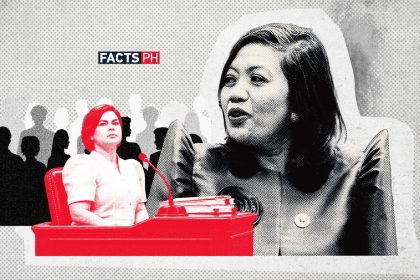

Vice President Sara Duterte’s defense has withdrawn all 16 bank representatives it initially planned to call in her impeachment trial. The official explanation is that their testimony is no longer necessary and that removing them will save time. But after several defense witnesses struggled to resolve questions about Duterte’s financial records, the decision deserves closer scrutiny.
The withdrawals suggest that Duterte’s lawyers are reassessing not only how many witnesses they need, but also whether putting additional people on the stand could expose weaknesses in their case.
Defense counsel Michael Poa said the bank representatives were no longer required. The last remaining witness, Bank of the Philippine Islands senior vice president Paul Roderick Ysmael, was expected to authenticate a letter Poa had already acknowledged writing. That is a legitimate procedural explanation. Courts do not need witnesses to establish facts that can be confirmed through documents or stipulations.
But the timing is difficult to ignore.
The defense initially considered the bank representatives important enough to seek their appearance. Their withdrawal comes after several witnesses called to clarify Duterte’s assets and financial interests instead faced difficult questions about discrepancies, missing documents and the limits of their knowledge.
Davao City Assessor Jaime Adalin was called to establish that a Matina property had been properly declared. His testimony left questions about differences in property values and identifying records. His changing answers concerning a trip to China also drew sharp criticism from senator-judges.
Samal City Assessor John Kenneth Enumerables confirmed that a barangay named in Duterte’s asset declarations did not exist under that name in Samal. He also could not establish with certainty that the titled property presented to him was the same one listed in the vice president’s declaration. An earlier land-title explanation may account for the outdated barangay name, but it did not settle every question about the property’s identification.
Davao City Accountant Vingelin Bajan faced scrutiny over her past connection to an accounting firm that audited companies linked to Duterte.
Then came GenCorp lawyer Suzette Balucanag-Punay.
Her testimony was intended to challenge a significant portion of the financial allegations. She maintained that Duterte received only ₱2.14 million from GenCorp between 2022 and 2025, contradicting the much larger amount attributed to her in the prosecution’s forensic report. Yet Punay could not explain how Duterte’s documented ₱46,875 capital contribution was connected to ₱2.14 million in subsequent payments. She also acknowledged that the payments represented income, regardless of whether they were described as a return of capital or a return on investment.
These difficulties do not establish Duterte’s guilt. The prosecution must still prove its allegations, and the defense remains entitled to challenge the evidence.
But the testimony illustrates a recurring problem: witnesses brought forward to strengthen the defense have sometimes introduced new uncertainties under questioning. That is why withdrawing all 16 bank representatives cannot be viewed solely as an administrative decision to shorten proceedings.
Every witness creates an opportunity to establish a fact. Every witness also creates a risk.
Once cross-examination begins, lawyers cannot control every answer. Documents may contradict recollections. A witness may lack knowledge of the transaction being examined. An explanation that appears convincing in preparation may become much less persuasive when tested publicly.
Duterte’s lawyers have now seen those risks materialize repeatedly.
It is therefore reasonable to examine whether the decision to withdraw the bank representatives reflects a more cautious assessment of what additional testimony might accomplish.
The defense may have concluded that the bank witnesses would add little beyond documents already available. But another possibility is that their appearance could introduce further questions without materially strengthening Duterte’s position.
The distinction matters because the underlying financial allegations have not disappeared.
The impeachment case includes an allegation of ₱817.87 million in unexplained wealth, supported by a forensic reconstruction of financial transactions, assets and declared income. Removing witnesses from the schedule does not remove those records from the proceedings.
Duterte’s lawyers still expect to present approximately eight to 10 additional witnesses. For now, however, the defense’s changing approach raises a question about its confidence in the usefulness of further live testimony.
The relevant issue is not whether a shorter defense presentation is acceptable. After several witnesses encountered difficulties under scrutiny, the decision to withdraw all 16 bank representatives points to a defense increasingly conscious of the risks created by its own testimony.
That is not proof that the defense lacks answers. But it is a reason to question whether its lawyers have begun to see some of their planned witnesses as potential liabilities rather than reliable support. The defense is not merely shortening its witness list. It appears to be reconsidering how much risk it can afford to take when its witnesses face questioning.