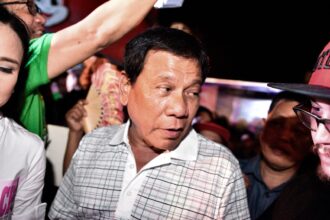

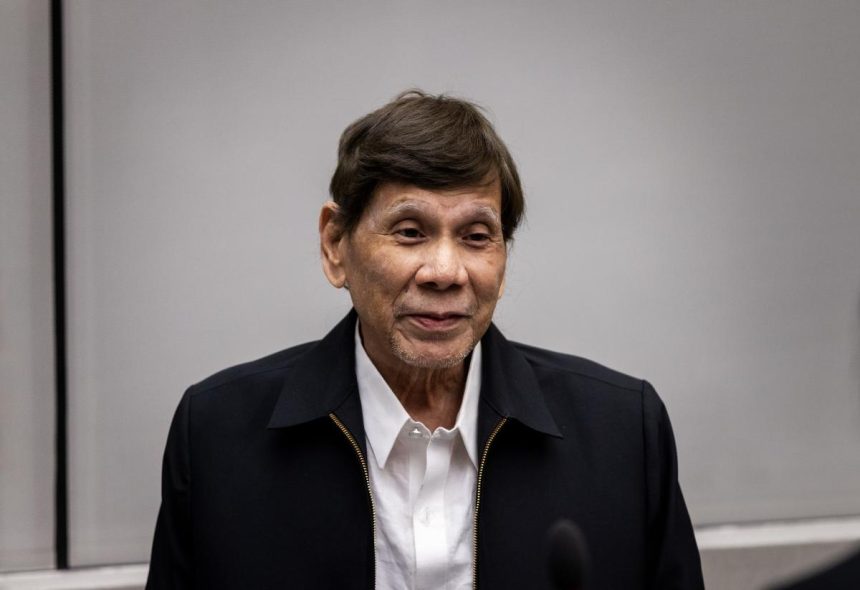
Former President Rodrigo Duterte’s crimes against humanity trial will open at the International Criminal Court on Nov. 30, beginning a new phase of proceedings that will put prosecution witnesses and evidence before three judges in The Hague. The hearing is scheduled to begin at 10 a.m. in The Hague, or 5 p.m. in the Philippines.
Duterte faces three counts involving murder and attempted murder as crimes against humanity. The charges have been confirmed for trial, but that does not amount to a finding of guilt. Prosecutors must prove the charges beyond a reasonable doubt before Trial Chamber III can convict him.
What Duterte is charged with
The prosecution alleges that killings committed in the Philippines formed part of a widespread and systematic attack against a civilian population between Nov. 1, 2011 and March 16, 2019. The three confirmed counts cover different periods and alleged operations.
Count 1 concerns alleged murders in Davao City during Duterte’s time as mayor, between 2013 and around June 2016.
Count 2 covers alleged murders of so-called “High-Value Targets” in different parts of the Philippines between around July 2016 and July 2017, after Duterte became president.
Count 3 concerns alleged murders and attempted murders during barangay clearance operations across the country between around July 2016 and September 2018.
The allegations will now be tested through evidence and witness testimony before the trial judges.
What happens on the first day
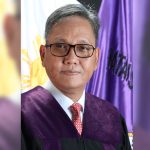
Trial Chamber III is composed of Presiding Judge Joanna Korner, Judge Keebong Paek and Judge Nicolas Guillou. At the opening, the judges will first confirm that Duterte understands the charges against him. He will then be asked whether he admits guilt or pleads not guilty.
The prosecution will give its opening statement, followed by the Common Legal Representatives of the Victims. Prosecutors have been granted six hours for their opening presentation, while the victims’ lawyers have three hours. The defense may also make an opening statement if it chooses to do so.
The court has scheduled four one-hour sessions each hearing day.
Once the opening statements are completed, the first prosecution witness is expected to take the stand. The ICC says the first five prosecution witnesses are expected to testify before the court’s winter judicial recess begins on Dec. 18. Prosecutors currently anticipate calling about 100 witnesses over the course of their case.
Victims will participate separately from witnesses
The court has confirmed that 539 victims who participated during the pre-trial stage will automatically continue as participating victims during the trial, while additional applications can still be processed. Participating victims are represented by their own lawyers and may present their views and concerns to the court. Their role is different from that of witnesses, who provide evidence relevant to determining the facts of the case.
Victims’ lawyers have already asked the court for extensive protections for many witnesses, including closed sessions, pseudonyms and voice distortion, arguing that identification could expose witnesses or their families to intimidation or other harm.
Evidence disputes remain unresolved
Several important evidentiary questions remain before the trial opens. Duterte’s lawyers have asked the court to exclude the previously recorded testimony of P-0002, a former Davao City police officer whom the defense describes as a central prosecution witness.
The defense argues that prosecutors have not adequately demonstrated why the witness cannot testify in person and has challenged the reliability and corroboration of his account. Victims’ lawyers support admission of the testimony, citing the witness’s position and claimed first-hand knowledge.
Trial Chamber III has not yet ruled on that request.
A separate, heavily redacted dispute concerns another defense attempt to challenge material before prosecutors formally submit it as evidence. Prosecutors argue that the request is premature and violates the chamber’s procedure, which generally requires admissibility objections to be raised when the evidence is actually presented. Because much of the filing is redacted, the specific material involved has not been publicly disclosed.
These disputes could shape what evidence the judges ultimately hear and how some witnesses appear before the court.
What happens after the prosecution finishes
The prosecution will present its witnesses and evidence first. The victims’ legal representatives may then make observations, after which Duterte’s defense will have the opportunity to present its own case and call witnesses. Only after the evidence and final arguments are completed will the three judges deliberate and issue a judgment.
The ICC has not set a date for a verdict.
Duterte was surrendered to the ICC in March 2025. Pre-Trial Chamber I unanimously confirmed all three charges in April 2026, and Trial Chamber III later found him fit to stand trial.
The Nov. 30 hearing will be streamed by the ICC with a 30-minute delay.