
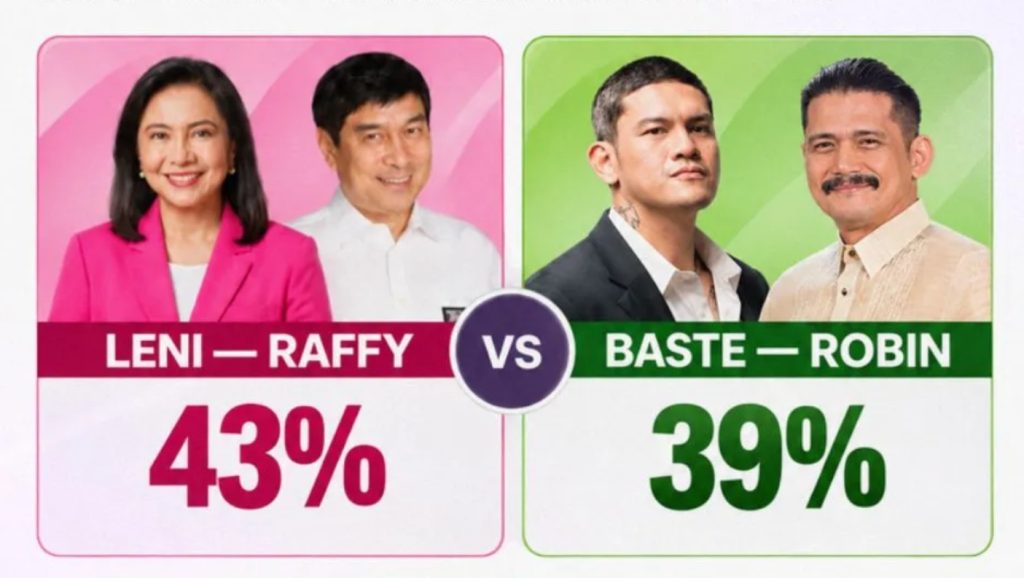
The Duterte family retains support in Mindanao, but new polling suggests that its ability to convert that regional strength into a national majority may be weakening as the 2028 election cycle begins to take shape. OCTA Research’s first hypothetical tandem survey found that a Leni Robredo–Raffy Tulfo ticket would receive 43% of the national vote against 39% for a Sebastian “Baste” Duterte–Robin Padilla tandem.
Another 18% of respondents chose neither tandem or said they did not know.
Among the 1,170 respondents who identified themselves as registered voters, the result was almost unchanged: 43% for Robredo–Tulfo, 40% for Duterte–Padilla and 17% uncommitted.
It is still early to describe the result as a decisive national rejection of the Duterte camp, but the regional breakdown shows the limits of the coalition that currently supports it.
The Duterte–Padilla tandem dominates Mindanao by 81% to 4%, with support reaching between 84% and 90% in the Davao Region, SOCCSKSARGEN, Caraga and the Bangsamoro Autonomous Region in Muslim Mindanao. Nearly half of all Duterte–Padilla supporters, 47%, come from Mindanao.
Outside that base, however, the picture changes sharply. Robredo–Tulfo leads 61% to 19% in Balance Luzon and 49% to 32% in Metro Manila. Its support rises to 69% in North Luzon. The tandem also leads in Western Visayas and the Negros Island Region. About 80% of Robredo–Tulfo supporters live in Luzon.
The divide is also visible across language groups. Robredo–Tulfo leads among Tagalog or Filipino speakers by 54% to 24% and among Ilocano respondents by 80% to 8%.
Duterte–Padilla, by contrast, leads 75% to 10% among Cebuano or Bisaya respondents.
Socioeconomic differences are much less pronounced. Class D, which represents about four in five Filipino adults in the survey, is split evenly at 41% for each tandem. Robredo–Tulfo leads among Classes ABC and Class E, while Duterte–Padilla performs better among respondents in the D2 segment of Class D.
Gender, age and location also divide the hypothetical coalitions. Robredo–Tulfo leads among women, urban residents, voters aged 45 and older and college-educated respondents. Duterte–Padilla performs better among men, rural voters and respondents aged 25 to 44.
The Visayas remains one of the most competitive areas. Duterte–Padilla leads there 43% to 41%, a difference too small to establish a clear advantage given the survey’s uncertainty. The 18% uncommitted vote is equally important.
That bloc is more than four times larger than the national gap between the two hypothetical tandems and is particularly concentrated in South Luzon and among younger voters. In CALABARZON, 32% were uncommitted, while the figure reached 36% in rural South Luzon.
Those voters could substantially alter the balance once actual candidates, alliances and campaign issues become clearer. The results also fit into a broader, though still preliminary, pattern in OCTA’s 2026 polling.
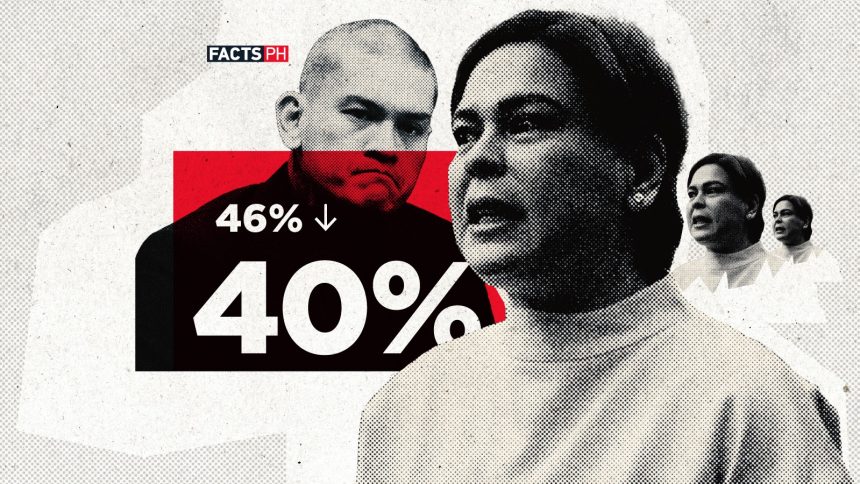
In separate hypothetical presidential matchups against Robredo, Vice President Sara Duterte’s national support fell from 46% in the first quarter to 43% in the second and 40% in the September 28 to October 4 survey.
Robredo’s support did not rise correspondingly, remaining broadly stable. Instead, the undecided share increased.
OCTA itself said that pattern may indicate some softening in Duterte’s support, while cautioning that three data points are not sufficient to establish a long-term trend.
The new tandem survey adds another piece to that picture. It does not demonstrate that voters are abandoning the Duterte family nationwide, but it shows that the family’s formidable Mindanao base is not automatically translating into a national advantage.
There are also major reasons not to treat the survey as an election forecast. Neither tandem exists. Robredo said in April that she would not seek the presidency in 2028 and repeated on November 9 that she intends to seek reelection as mayor of Naga City rather than return to national politics.
Baste Duterte has not declared a presidential candidacy.
The survey was conducted from September 28 to October 4, more than a month before Robredo’s latest statement. It therefore does not measure voter reaction to her decision. The fieldwork also coincided with the Senate impeachment trial of Vice President Sara Duterte. OCTA said no conclusion can be drawn from the poll about whether the proceedings affected voter preferences.
The survey involved face-to-face interviews with 1,200 adults nationwide and carries a ±3 percentage-point margin of error at the 95% confidence level.