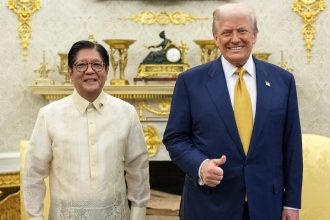

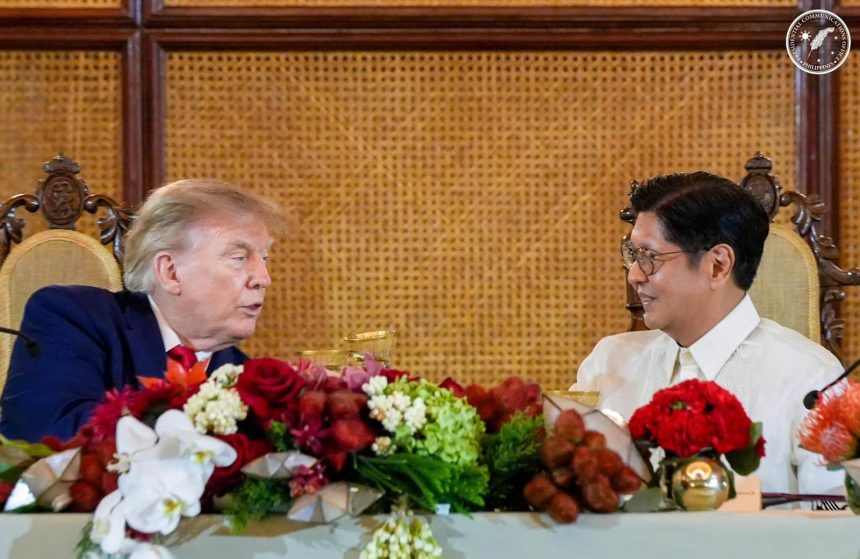
The Philippines and the United States will pursue a defense financing loan package worth more than ₱127 billion, part of a broader set of military, technology and infrastructure commitments announced after President Donald Trump’s visit to Manila.
The White House said the Foreign Military Financing, or FMF, loan would allow the Philippines to acquire critical defense and security capabilities from US suppliers. Washington said the package is expected to support more than 7,000 American jobs.
Separately, the United States said it would use about ₱25.5 billion in FMF for the Philippine military to expand its operational reach and deterrence capabilities in the South China Sea. The planned acquisitions include long-range fires, command-and-control systems, critical infrastructure and multi-domain drones.
The Philippine Department of National Defense has also announced a roughly ₱2.35 billion contract with an unnamed US company for what the White House calls “Super Intelligence,” or SI-enabled, mission support. Another initiative worth around ₱4 billion would modernize the country’s defense cloud infrastructure for SI applications.
Beyond defense, Washington outlined several commercial and infrastructure projects.
US satellite company Astranis is offering connectivity services through its AGILA satellite in a commercial opportunity worth up to about ₱12.7 billion. Subic Grain plans to build a fuel storage facility at Subic Bay worth roughly ₱2.5 billion to support military and commercial operations. The two governments also announced plans to modernize Basco Airport in Batanes to improve access, disaster response and supply chains.
The largest commercial deal announced by the White House is a roughly ₱763.6 billion sale involving Boeing and GE Aerospace for up to 20 Boeing 787 aircraft for Philippine Airlines. The US government said the transaction would support 47,000 American jobs.
The announcements followed Trump’s meeting with President Ferdinand Marcos Jr. in Malacañang, where Trump said the two countries had reached a major trade deal. Philippine officials later described the outcome more narrowly as an understanding on economic cooperation, with details on food, energy and trade still to be negotiated.
The White House also said both governments committed to reducing the US trade deficit with the Philippines through increased Philippine purchases of American energy and agricultural products. No timetable, import targets or detailed financing terms for the proposed defense loan were disclosed.