

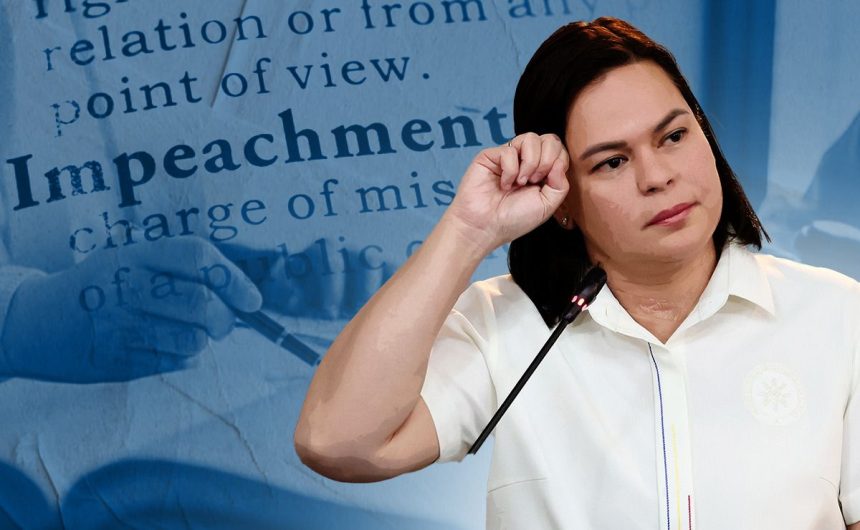
Vice President Sara Duterte now faces a single article of impeachment: Article II, on alleged unexplained wealth. The narrowing has made the trial simpler to follow, but it has also changed what the case is about. It is no longer mainly about how confidential funds were spent. It is about whether a public official’s declared finances add up.
How the case narrowed
On October 13, the Senate impeachment court approved the House prosecution’s request to withdraw three of the four original articles, Reuters reported. The dropped charges alleged misuse of confidential funds, bribery, and threats against President Ferdinand Marcos Jr., the First Lady and a former House Speaker.
Lead prosecutor Gerville Luistro said narrowing the case would speed up the trial and that the evidence on unexplained wealth was strong enough on its own. According to AP, the remaining charge alleges that Duterte failed to report wealth as required by law and that she and her husband held prohibited business interests. The Khaleej Times reported that the prosecution puts the alleged unexplained wealth at P817.87 million for 2022 to 2025.
The defence objected, arguing it was unfair to drop charges after evidence on some had been aired, leaving Duterte no venue to answer them in court.
What “unexplained wealth” means in law
The charge draws on long-standing rules. The Constitution requires public officials to submit a sworn statement of assets, liabilities and net worth (SALN). The Code of Conduct and Ethical Standards for Public Officials, Republic Act 6713, sets out what must be disclosed. A separate law, Republic Act 1379, allows the state to seek forfeiture of property that is manifestly out of proportion to an official’s salary and lawful income, which is presumed unlawfully acquired unless explained.
Impeachment is not a forfeiture case. The Senate cannot seize property or impose prison terms. It decides only whether the official should be removed and disqualified from office. The prosecution must therefore persuade senator-judges that the alleged gap between declared and actual wealth amounts to an impeachable offence, such as culpable violation of the Constitution or betrayal of public trust.
The Corona precedent
The Philippines has been here before. In 2012, the Senate convicted Chief Justice Renato Corona on the article alleging he failed to disclose assets in his SALN. He was removed by a 20-3 vote. Corona argued that some deposits were protected by bank secrecy laws and denied wrongdoing.
That case showed a SALN-based charge can succeed in an impeachment court. It also showed how disputed such cases can be: what counts as an asset, how foreign-currency deposits are treated, and what standard of proof applies were all contested. Similar questions are likely to arise now.
Where the trial stands
As of October 26, the prosecution has rested on Article II and filed its formal offer of evidence. The defence has 10 days to comment and begins presenting its case on November 9. The gag rule on the withdrawn articles has been lifted.
The vote count has also changed. In September, the court ruled that the two-thirds requirement would be counted only among senators able to participate, excluding those detained, suspended or beyond Senate processes. The Supreme Court dismissed two petitions against that ruling on procedural grounds.
What remains unestablished
Several points have not been tested. The prosecution’s wealth estimates come from its own witnesses and analysis. The defence has not yet presented an explanation of the figures or of Duterte’s business interests. Senator-judges have not ruled on which exhibits are admissible.
A single-charge case is easier to judge on its merits. It also means the outcome will rest on the quality of the financial evidence, not on the breadth of the allegations.
No verdict has been reached. Duterte has broadly denied the allegations.