
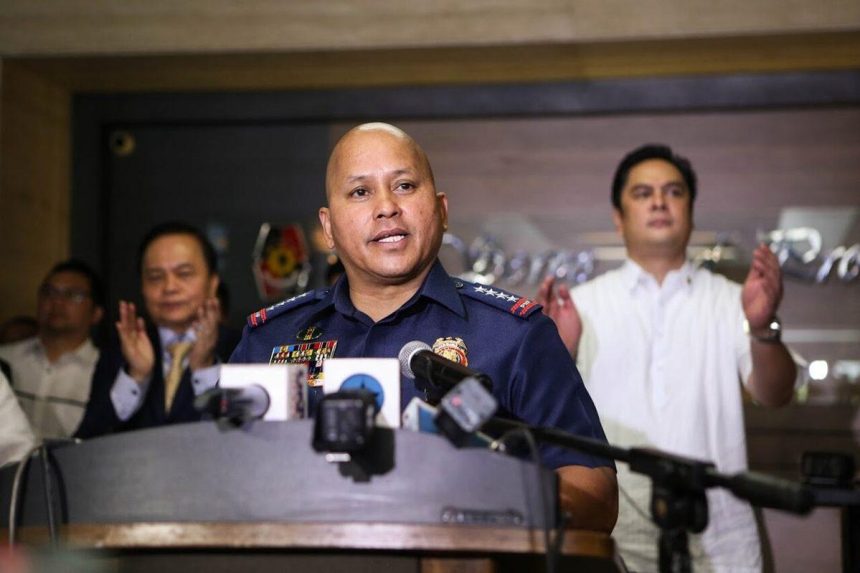
The government has promised to arrest Sen. Ronald “Bato” dela Rosa, who is wanted under an International Criminal Court (ICC) warrant. As of October 26, he had not been arrested. The gap between the promise and the result now involves a bounty, a deadline, a Supreme Court challenge and a sitting senator who has not appeared in the Senate. It is also a test of how the Philippines handles international accountability for the drug war.
What has been promised
Palace press officer Claire Castro said on October 24 that President Ferdinand Marcos Jr. ordered police to act quickly but without loss of life. The government has offered a P50-million bounty, and Philippine National Police chief Gen. Jose Melencio Nartatez Jr. gave dela Rosa one week to surrender.
Interior Secretary Jonvic Remulla said an Interpol red notice is in force. He also said authorities were negotiating his turnover with the group sheltering him; the group was not identified. On October 21, the Palace urged dela Rosa to give himself up and face the warrant. Philippine officials have said they would hand him to the ICC if he is captured, AP reported.
What the warrant says
The ICC names dela Rosa as an alleged co-conspirator of former President Rodrigo Duterte in its drug war case. Dela Rosa led the national police from 2016 to 2018, when the anti-drug campaign began. The warrant charges him with murder as a crime against humanity, covering at least 32 killings between July 2016 and April 2018.
These are allegations. No court has found dela Rosa guilty of anything. He has consistently defended the anti-drug campaign.
The legal fight
Dela Rosa’s lawyer, Israelito Torreon, called the bounty invalid. On October 24, the defence challenged the bounty and arrest order before the Supreme Court, arguing that an international warrant cannot be enforced without a Philippine court order. His camp also argues that Section 17 of Republic Act 9851, the Philippine law on crimes against international humanitarian law, makes surrender to an international court optional rather than mandatory. The Supreme Court rejected his earlier plea for a temporary restraining order in May.
The government’s position rests partly on precedent. In March 2025, Rodrigo Duterte was arrested in Manila on an ICC warrant and flown to The Hague the same day. His trial there is scheduled to start on November 30. The Philippines withdrew from the ICC’s founding treaty in 2019, but the court has held that it keeps jurisdiction over crimes allegedly committed while the country was a member.
The Senate minority bloc wants dela Rosa tried at home, not abroad.
The institutional cost
A senator in hiding creates problems the Constitution did not anticipate. Senate President Sherwin Gatchalian said dela Rosa’s salary and office funds have stopped because staff cannot reach him to sign documents. Sen. Panfilo Lacson said the Senate had already formally excluded fugitive senators from the count used to compute the two-thirds vote in the Sara Duterte impeachment trial.
That means dela Rosa’s absence affects the trial’s arithmetic. His arrest, by contrast, would not restore him to the count, since detained senators are also excluded.
Promise versus result
The government has made a clear commitment with a deadline. The record so far shows announcements, an incentive and legal steps, but not an arrest. Two outcomes would close the gap: a surrender or an arrest, followed by a turnover to the ICC. A third, a Supreme Court ruling against enforcement, would change the terms entirely.
What to watch
Key markers include whether dela Rosa surrenders before the PNP deadline, how the Supreme Court acts on his petition, whether the group sheltering him is identified, and whether any arrest is carried out without violence, as the President ordered.